The short answer
A reliable voice journal writes a playable audio file before it depends on the network or an AI provider. It should then give the upload and transcription a durable identity, show what is still pending, retry without creating a second entry, and leave the original recording available if processing fails.
“Your entry is safe” is not a useful technical description. The question is which artifact is safe, whether audio, transcript, edited journal text or all three, and where each artifact exists.
The seven tests
Use a harmless recording such as: “This is a reliability test recorded at 3:15.” Do not use a real private entry.
1. Finish while offline
Enable airplane mode, record for 20 seconds, and finish. A local-first app should still create a visible entry or recoverable draft with playable audio. If the recording disappears because upload could not begin, the network rather than the device is the real source of truth.
2. Force-quit immediately after finishing
Finish a second test recording and close the app before transcription completes. Reopen it. The app should find the same pending entry and resume; it should not silently abandon the work or create a duplicate.
3. Interrupt the upload
Start online, finish recording, then remove connectivity while the upload is in progress. Restore connectivity a minute later. A durable upload should continue or retry against the same entry identifier.
4. Separate audio failure from AI failure
If transcription fails, replay the original recording. A provider outage should not be able to erase a file that was already saved on the phone. The UI should say that processing failed, not that the recording failed.
5. Try silence
Record several seconds of silence. “No speech detected” is a valid input result, not evidence that the provider is down. A trustworthy app distinguishes this from a network, authentication or processing failure.
6. Verify what deletion means
Delete the test entry and check local playback, cloud sync and the product’s privacy policy. Device audio, private-cloud copies, transient processing audio and retained processed text can have different deletion paths. A single “encrypted and private” badge does not answer this.
7. Repeat with a longer recording
Run the first four checks with a five-minute synthetic recording. Short samples can hide upload timeouts, background limits, memory pressure and partial files.
A scorecard you can reuse
| Check | Minimum trustworthy result |
|---|---|
| Local finish | A visible, playable local recording exists without a network |
| Relaunch | The same entry resumes instead of restarting or duplicating |
| Upload retry | Retry uses a stable identifier and preserves local audio |
| Provider failure | Audio remains playable and the failure is described accurately |
| Silence | No-speech is separated from infrastructure failure |
| Deletion | Device, cloud, processing audio and processed text are explained separately |
| Longer entry | The same guarantees hold beyond a tiny demo recording |
A measured Journo baseline, with limits
On 22 August 2026 we submitted the same 24.4-second synthetic recording to a local Journo stack connected to its real transcription and journal-processing providers. Readable text returned in 9.7 seconds. Against the fixed script, the raw transcript had 0 lexical word errors, and the cleaned entry changed 0 words; it only changed punctuation and paragraph breaks.
This is one controlled baseline, not an accuracy claim for spontaneous speech, different accents or noisy rooms. It measures the server path, not the time a phone spends uploading. The run did not test offline capture, local audio retention or force-quit recovery, so those fields remain not tested rather than being inferred from Journo’s own implementation.
The dated machine-readable result contains the fixed audio hash, timing, transcript, lexical edit counts and hash-verified response evidence. The same corpus is prepared for AudioNotes, Voicenotes, Cleft, ChatGPT and Untold; none will be shown as measured until the identical recording has been run through that product with visual evidence.
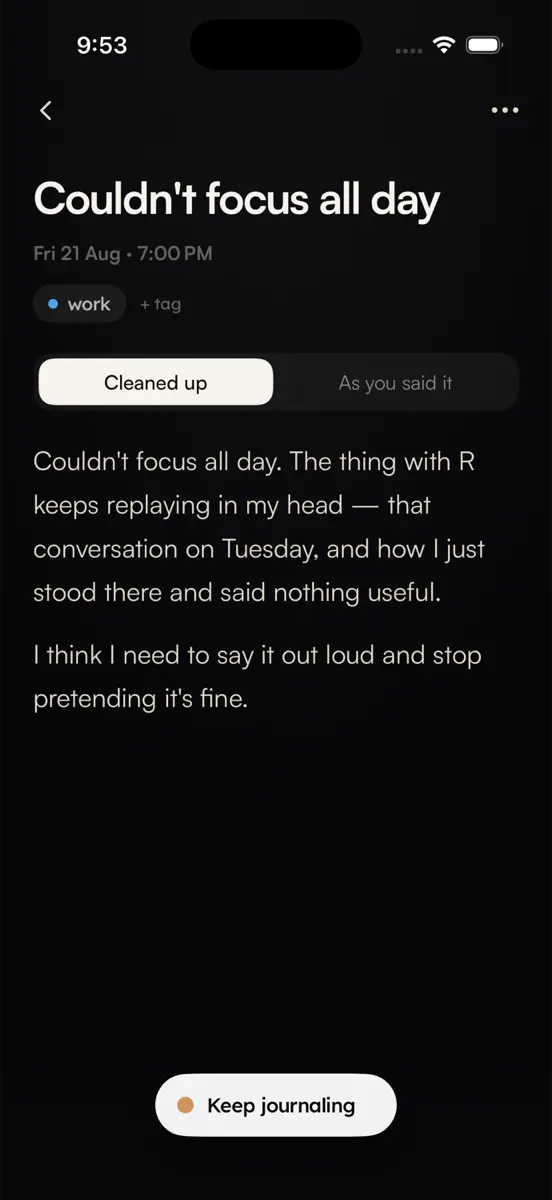
Journo 2.0 completed-entry interface, captured in August 2026. This product screenshot illustrates the result state; it is not substituted for benchmark evidence.
How Journo 2.0 behaves
Journo writes the recording to the iPhone before remote processing begins. The recording remains available for playback even when upload, transcription or journal generation fails. Upload and processing use the recording UUID as a durable task identity, so work can resume after relaunch without holding a long request open.
The server stores accepted work in a durable database queue before returning, and processing audio is removed after the attempt; a seven-day storage rule is a safeguard for abandoned uploads. Journo distinguishes no-speech results from provider failures and keeps the original audio independent of generated text.
One limitation matters: the current App Store build reliably deletes local and private-iCloud entry data, but may not send deletion of retained backend text after a completed entry. Until the client-side deletion repair ships in a later binary, use the privacy request on Journo Support for broader backend-text deletion. The controlling details are in the Privacy Policy.
Why this matters more than transcript accuracy
Accuracy can be reviewed against the original recording. A vanished recording cannot. For a personal journal, capture durability is therefore the first quality gate; transcription style, summaries and AI features come after it.
When comparing apps, run the seven tests before importing an archive or trusting the app with the entry you cannot recreate.
Sources and verification
We use first-party product documentation and original research wherever possible. Features and prices can change.